Background
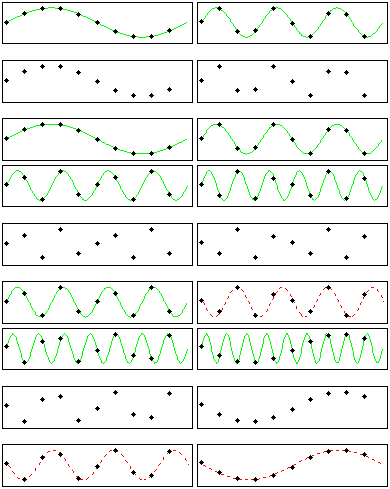
Consider a digital audio system and a steadily rising sine wave tone.
At lower frequency, the tone is sampled with many points per cycle. As the tone rises in frequency, the cycles get shorter and fewer points are available to describe it.
At half the sampling rate, only two samples are available per cycle. We are at the limit stated by Nyquist. Still, those two samples are sufficient to reconstruct the original signal.
If the tone keeps on rising, the number of points per cycle becomes inadequate to represent the signal. Those samples will be misinterpreted by the digital-to-analog converter and will be associated with a wrong frequency. This phenomenon is referred to as aliasing.
The Test Files
| Aliasing Check 44.1kHz Sample Rate |
After the three beep tones, a -3 dbFS sweeping sine tone from 22 kHz (half the sampling rate at 44.1kHz) down to 1 kHz.
As the test starts by playing frequencies that are probably beyond your audible range, you won't hear anything for a moment, except the three starting beep tones. When the frequency under test reaches your audible range, a high pitched sine tone will be heard, steadily decreasing down to 1 kHz.
If your hear anything different, your sound system likely suffers from (severe) aliasing. In this test, aliasing will appear as frequencies increasing instead of decreasing.
To check whether aliasing is genertated by your browser's audio plug-in or your sound card, download the original file (click the download arrow) and play the test tone straight from your hard disk through your favorite audio application.
| Alternate test 48kHz Sample Rate |
Alternatively, you can try the 48 kHz version of this test. Beware: all other test files available on this site are 44.1 kHz.
Related pages
Other Aliasing Tests
- Aliasing Blind Test (44.1 kHz v/s 48 kHz)
- Aliasing Test Files at higher Sample Rates (up to 192 kHz)
External Links
Help Me Help You!
Is AudioCheck free? Not for me. Your support keeps this site running. Any donation will be rewarded with • uncompressed .wav file download for every test (a download arrow will appear next to each sound icon) • increased durations and sample rates up to 192 kHz in the Tone Gen section • and, best of all, the removal of these pesky payment buttons below 😜

If you already are a patron, please log in.
Frequency Response Tests
Stereo Imaging Tests
Dynamic Range Test
Room Tests
Distortion Tests
